Old vines, tariffs and changing tastes: California Buyers Marketplace confronts a range of issues

The way Wanijiru Mureithi sees it, Africa is the next frontier for wine sales — a new continent full of opportunity for California wines.
Kenya, her home country, is a wine importer, said Mureithi, a wine consultant. “We are open.”
The country, which has a port, is the gateway to the region, she said.
“California,” Mureithi added, is a “big brand. “It’s a big name. It’s America!
“How difficult would it be to sell?”
Mureithi was among the more than 100 trade members from three-dozen countries who attended this year’s California Buyers Marketplace Oct. 16-29 at CIA at Copia in Napa under the leadership of Wine Institute, the trade association that represents California wines. The event dovetailed with the Old Vine Conference Oct. 31-Nov. 2.
Global Buyers Marketplace, organized to connect buyers to California wine producers, met as wine consumption continues to decrease in the United States and around the globe. Buyers tasted wines from more than 300 wineries across California at grand tastings scheduled at CIA at Copia over two days, followed by 1½ day of visits to wineries in the region, including Sonoma, Napa and Lodi.
Jancis Robinson on the future of wine
Featured speakers included British wine critic Jancis Robinson, who founded JancisRobinson.com 25 years ago.
Robinson, who started her wine writing career in London in 1975, said she remained optimistic about the future of California wine at a time when white wines are becoming popular once again.
There is now a much wider choice of wine available, Robinson also said during break at the conference. She also praised California’s sophisticated production techniques.
How will California wines fare? “It will be fine,” Robinson said. “There is a lot of money here, and it’s certainly not going to disappear.”
Robinson and members of her team at JancisRobinson.com discussed the evolution of the wine industry during a panel on Oct. 29 that marked the site’s 25th anniversary.
When Robinson started as assistant editor at Wine & Spirit magazine 50 years ago, Sherry was the most popular wine in the United Kingdom, Robinson recalled.
White wines were far more popular than red wines. Then came the critics’ wine scores, which Robinson said, “completely revolutionized the wine world” both for the good and bad.
Consumers, including non-English speakers, could understand these numbers, Robinson said.
At the same time, however, scores engendered stylistic change in wines. The most powerful wine critics, who were Americans, seemed to have the same taste, Robinson added. All over the world, wine producers were chasing high scores by making wines to fit that taste.
Retailers relied on wine scores and “overlooked what their job was, which was to select wine that they really, really liked and then explained it to their customers,” Robinson said.
“The scores, I believe, were overused and chased,” Robinson said.
Over time, winemakers grew tired of that wine style. “Now we see much lighter, fresher wines,” Robinson said.
Robinson shared the stage with Alder Yarrow, a columnist, and Samantha Cole Johnson, senior editor at JancisRobinson.com.
Old vines produce better wines and are resilient, speakers said during both conferences. “Old vineyards have great stories to tell,” Robinson said.
Yarrow helped create the old vine registry at JancisRobinson.com. The project, which began in 2019, now includes more than 8,100 entries, Yarrow said. The entries include a link to wines produced with fruit from the listed vineyard, all in an effort to help keep the old vines in the ground and save these historic properties.
Younger winemakers are seeking to produce wines that are different in style than before, Yarrow said. Consumers’ taste is also changing, he said, reflecting on the shift back toward white wines.
Samantha Cole Johnson, senior editor at JancisRobinson.com, attributed the decline in wine consumption to the amount of time spent online instead of with other people. People tend to drink with friends, she said.
In 2000, people spent seven hours a week with friends. They now spend 2 hours and 20 minutes a week with friends, she noted citing research data.
Yarrow also noted how tariffs are affecting the industry: they are not good for anyone, he said.
They make imported wine bottles and corks – and wine production – more expensive. In addition, if distributors, retailers and importers go out of business because they are no longer financially sustainable in the face of these tariffs, U.S. wine producers lose a vehicle to reach customers, Yarrow said.
Another consideration for wine sales today is relations with Canada. Canadians have been boycotting U.S. wines after President Donald Trump said the country should become part of the United States. Yarrow said there were a lot of Canadians in South Africa when he visited that country recently. The South Africans were “really happy” to see them, he added.
Jeffrey Bart, wine importer at Wijimport J. Bart from Amsterdam, Netherlands, said his company has done business with U.S. wine producers for years.
“Of course, it’s not an easy market at the moment,” he said. Clients associate U.S. wines with Donald Trump. Yet his company stands by the quality of the wines of the Napa Valley and tries to focus on the wines.
During the panel that marked JancisRobinson.com’s 25th anniversary, Ievgeniia Nikolaichuk, head of wine projects for Silpo stores in Ukraine, thanked Robinson for publishing Letters from Kyiv from various contributors after Russia’s invasion of Ukraine. The letters, written by various authors, reported on the war, including on winemakers’ deaths, wine warehouse bombing, and other war-related losses.
“I don’t have any questions. I just wanted to say, ‘thank you’ to the team and to Jancis,” Nikolaichuk said during a question-and-answer session.
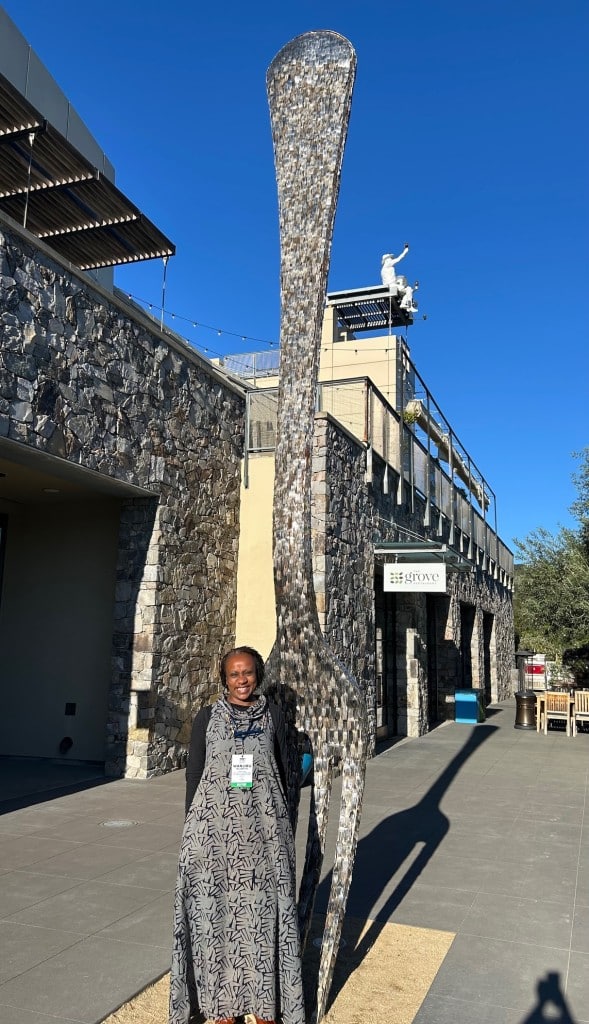
Nikolaichuk, Mureithi and other attendees at California Buyers appreciated the convenience of being able to taste wines from so many wineries in one spot. They looked forward to visiting wineries in the region.
“You can read books and you can drink the wine and you can watch all the YouTube videos you want, but there’s something so special about being on location and hearing the story,” Mureithi said. And of course, most vineyards are beautiful places to visit, isn’t it?”
The attendees were invited to take part in a tasting of old vine wines from California and around the world, followed by a discussion between Robinson and legendary Ridge Vineyards winemaker Paul Draper, followed by a gala dinner at CIA at Copia.
Draper recalled producing his first Zinfandel from an old vineyard called Picchetti in 1969, the year he joined Ridge Vineyards in Santa Cruz. “It was phenomenal,” said Draper, a winemaker known for his single-vineyard productions.
The Old Vine Conference also set sessions in Santa Rosa and Lodi and included vineyard tours.