AI is coming to ag: It’s not if, but when
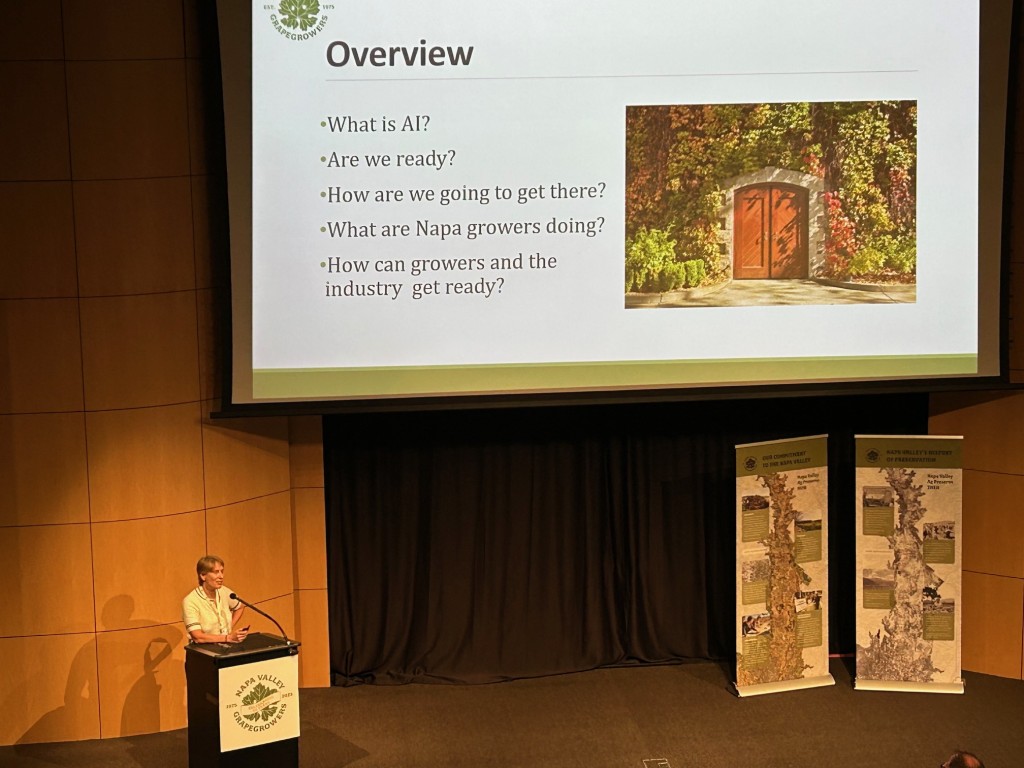
Grapegrowers survey the field at ‘Ahead of the Curve’
Precision agriculture, thanks to artificial intelligence, continues to help growers to decide when to plant, irrigate and harvest.
AI-enabled technology is used to estimate fruit yields, detect pest and pathogens in vineyards, monitor grape maturity and quality as well as water stress and irrigation and automate farm equipment.
Yet more can be done in viticulture, speakers at symposium on AI at Copia in Napa recently said.
Australian entrepreneur and technologist Ros Harvey was the keynote speaker on July 23 at “Ahead of the Curve,” an event sponsored by Napa Valley Grapegrowers. Harvey and other speakers said that AI can reduce costs and risks to growers.
A survey of 900 growers showed that more than 80 percent agreed AI and real-time data can improve outcome at lower costs, Harvey said.
However, only 15 percent of growers use drones or other flyover technology; 9 percent use AI sensors, and 3 percent use robotics in the field, Harvey said, citing Wine Market Council and Wine Business Monthly data.
“So, we’ve got a way to go,” said Harvey, founder of The Yield, now a division of Yamaha Agriculture, Inc.
The Yield, founded in 2014, uses AI to help agriculture, including winegrape growers, to grow specialty crops with less environmental impact.
AI is coming, ready or not, Harvey and others said during the symposium. “It’s not a question of if, it’s a question of when,” Harvey said.
“How do we make sure we shape this technology? How do we actually do that in a way that’s good for the industry,” Harvey asked. “How do we get ready?”
One of the biggest challenges is sorting out the data, making sure it is clean, speakers said. To that end, growers should have their data AI-ready.
Harvey also urged growers to protect their data. “Share it purposefully,” she added.
Growers must own their data, she said. Every time a company aggregates data, it’s not the same data, she noted. “If you’re not careful, you won’t own that.”
Unprotected data from a grower that is then shared may potentially be used later against that grower’s interests, including for fruit prices.
Another speaker, Jacob Harste, chief operating officer of Ag Code, Inc., said actions growers can take today include starting to collect and centralize data, defining goals and setting the right expectations. Like Harvey, Harste urged growers to retain ownership of their data.
Mason Earles, associate professor at UC Davis, said AI still falls short today with high-level viticultural planning and reasoning like creative thinking; having site specific data and knowledge of vineyards; quantitative understanding of biology, and automation of high-touch, fine-motor labor tasks, like pruning.
Harvey cited lessons learned from Napa Valley growers’ experience with AI.
In 2023, Atlas Vineyard Management turned to AI to focus on logistics, crew and equipment management. They hired a vendor, but when this turned out to be too expensive because of the complexity of farming variables, Atlas Vineyard paused the experiment.
The following year, the company pivoted to implement robotics in orchards to predict yield estimates and detect viruses.
Kelli Cybulski, director of sales and marketing at Atlas Vineyard Management, reported what the company learned from its experience with AI:
- Be clear on how to create business value
- It’s expensive. So, make sure you have strong backing. It’s a multi-year project.
- Make sure the data is clean.
- Make sure to understand what AI is and it can deliver now.
- Have champions – people who believe in it.
Foley Family Wines and Spirits has experimented with AI in collaboration with Yamaha Agriculture. This year’s focus includes yield prediction and harvest timing optimization, according to the company.
Kia Behnia, co-founder of Scout, an AI-based farm management platform, cited key lessons, including:
- AI consolidates data and summarize it into information and knowledge.
- Start with automated vine counts; layer performance monitoring, including fruit yield and virus mapping. Start with “the end in mind.”
- Ground truth sampling is “key to calibrate the AI model.”
- AI is only as good as the data.
Early innovators can make sure the technology works for them, Harvey said. Their data is sorted, organized. Still, things do go wrong.
But that is OK, Harvey said. Just make sure the business understands what it is getting into or maybe wait until the next season.