Elected officials discuss Napa County transportation efforts
What does it take to make transportation smoother, safer and healthier?
That’s a question elected officials from Napa County and others addressed on July 21 at a meeting in Napa organized by Democrats of Napa Valley.
Napa County Supervisor Belia Ramos, who represents American Canyon and south Napa County, gave updates on transportation issues that affect Napa and the San Francisco Bay area.
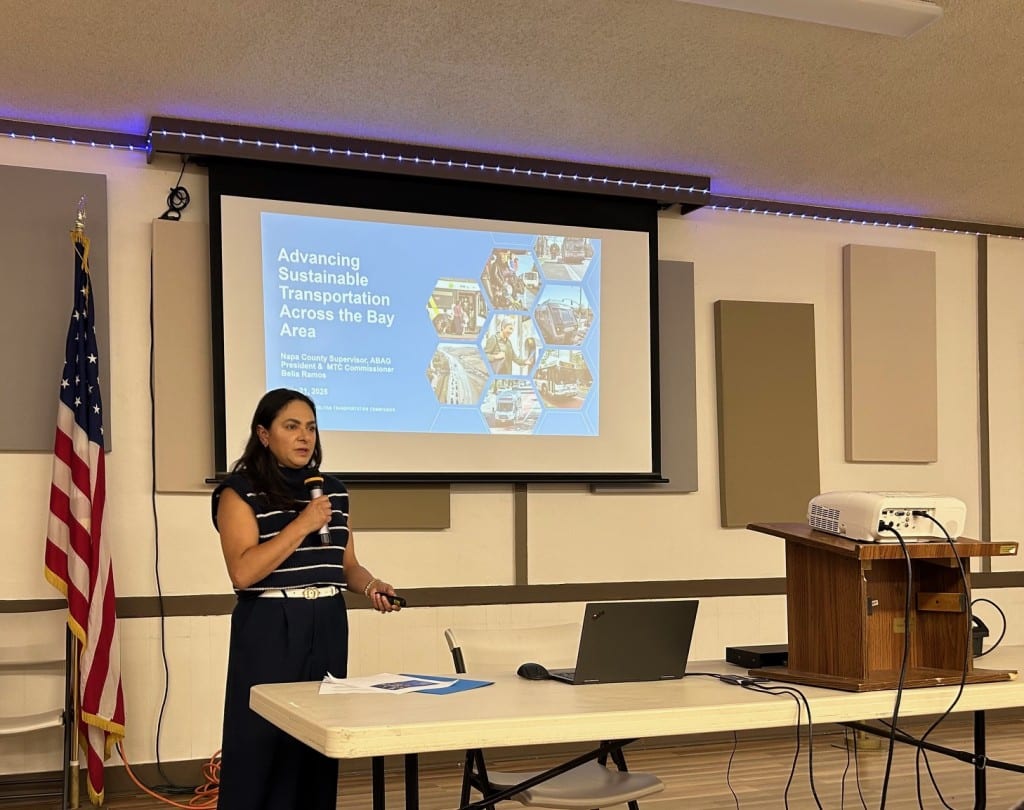
Ramos serves as president of the Association of Bay Area Governments and as a Napa County representative at the Metropolitan Transportation Commission. The agencies represent nine San Francisco Bay Area counties, including Napa County. ABAG focuses on housing while MTC concentrates on transportation.
For years, MTC and its partners have discussed interim and long-term solutions to improve Highway 37, the 21-mile link that connects I-80 in Vallejo to Highway 101 in Marin County. The road regularly floods causing road closures, leading to detours and traffic jams in American Canyon and south Napa County.
Tolls are planned between Mare Island in Vallejo and Sears Point over the next decade as efforts to upgrade the roadway continue.
“Even though that corridor itself isn’t within Napa County, we have placed ourselves at the table to make sure that we are in decision making power, because whatever decisions are made ultimately do affect us,” said Ramos during her presentation in front of about 30 members of Democrats of Napa Valley who gathered at the American Legion.
Input from MTC has shaped State Senate Bill 63, a bill introduced by State sens. Scott Wiener, D-San Francisco, and Jese Arreguin, D-Berkeley. If approved, it would impose a sales tax in Alameda, Contra Costa and San Francisco counties over 10 to 15 years to spare BART, Caltrain, AC Transit, and San Francisco Muni, from major service cutbacks.
These agencies –– and Golden Gate –– will face about $800 million in annual deficits beginning next year, according to MTC. San Mateo and Santa Clara counties may opt in later this summer.
Under SB 63, up to 5% of the funds raised annually would be set aside to improve the riders’ experience.
About 1 million people a day use public transit in the San Francisco Bay Area, home to about 8 million residents.
MTC and ABAG are also updating their latest long-term regional plan that serves as a blueprint for the region’s transportation, economic development, environmental resilience and housing needs. On July 17, ABAG’s executive board voted to advance the environmental review of the plan known as Plan Bay Area 2050 +.
The plan is required to obtain federal funding for various projects in the region. About $95 million worth of grants have been awarded to communities in the San Francisco Bay area since 2008.
A goal is to achieve transportation connectivity in a region as residents commute to further distances to earn wages that allow them to buy houses and pay for living expenses.
Another speaker at the meeting, Patrick Band, associate program planner and administrator at the Napa Valley Transportation Authority, said his agency is working on a countywide active transportation plan to spur walking, biking and the use of public transit and other alternative modes of transportation in the county. A first draft is set to be released later this year.
“We want to make sure people have options,” Band said.
Vine, the Napa-based public bus system, continues to recover from the pandemic years. About 600,000 people use Vine. However, 1 million people took Vine before the pandemic.
On average, residents in the city of Napa travel 35 miles per day, Band said. St. Helena’s residents post the highest vehicle miles traveled–– almost 85 miles per person per day.
With 30,000 car trips a day, Bel Aire Plaza, in the city of Napa, is the most popular destination in Napa County, Band said. These are car trips that could be converted, he said.
As part of the countywide active transportation plan, the Napa Valley Transportation Authority has prepared a survey of every street and sidewalk in Napa County. The survey found hundreds of gaps in the sidewalk network.
The Napa County Bicycle Coalition, which was formed in 2008, seeks to make riding a bike safe, convenient and accessible for people of all ages and abilities through education, advocacy and encouragement, said Kara Vernor, Napa County Bicycle Coalition’s executive director.
The League of California Bicyclists ranks bicycle-friendly communities. The city of Davis is a platinum-level bicycle-friendly community, said Vernor. Napa is bronze. “We want all of Napa County to get to the gold level,” Vernor said. “We have some work to do.”
One project the Napa County Bicycle Coalition has undertaken involves a bike-powered lane sweeper to clear debris on bike lanes.
The coalition raised money to buy the sweeper after Caltrans said flexible posts installed in 2024 along bike lanes on the Maxwell Bridge in Napa prevented street sweeper from clearing debris along the bike lanes. These flexible posts can reduce crashes by half, Vernor said.
American Canyon City Councilman David Oro, a longtime bike enthusiast, also addressed the Democrats of Napa Valley. He bikes across Highway 29 to city meetings from time to time.
“I hate it every time,” Oro said. He’s usually late. There is junk on the side of the road, he said. “It’s not good.”
Yet American Canyon is making improvements. The city has been installing bike lanes. “We’re putting bike lanes wherever we can,” Oro said.
The city is also working with Caltrans and NVTA on the Broadway/Highway 29 corridor.
An option under study is to replace traffic lights along the corridor with roundabouts in order to slow traffic.
Watson Ranch, the new development east of Highway 29, features raised elevated sidewalks which serves as speed bumps and increase pedestrians’ visibility to vehicles.
Another bike enthusiast, Calistoga City Councilman Kevin Eisenberg also spoke. Three out of the city’s five council members regularly bike to city meetings, Eisenberg said, adding that the Calistoga City Council is firmly committed –– as the budget allows –– to active transportation.
Calistoga has a very active transportation advisory committee said Eisenberg, a retired Calistoga Junior/Senior High School principal who serves on the panel as the city council liaison.
Calistoga has an accessible mountain bike trail. There are also three pedestrian/bicycle bridges which are part of a 3 ½ mile loop through Calistoga.
However, he said, the city lacks sidewalks; there are dangerous intersections; potholes are all over the place. The problem, Eisenberg said, is “money.”