Forum answers questions on ICE and policy changes for immigrants
How can employers better protect their employees from U.S. Immigration and Customs Enforcement agents? What happens if ICE agents show up? What are the main changes to immigration policies?
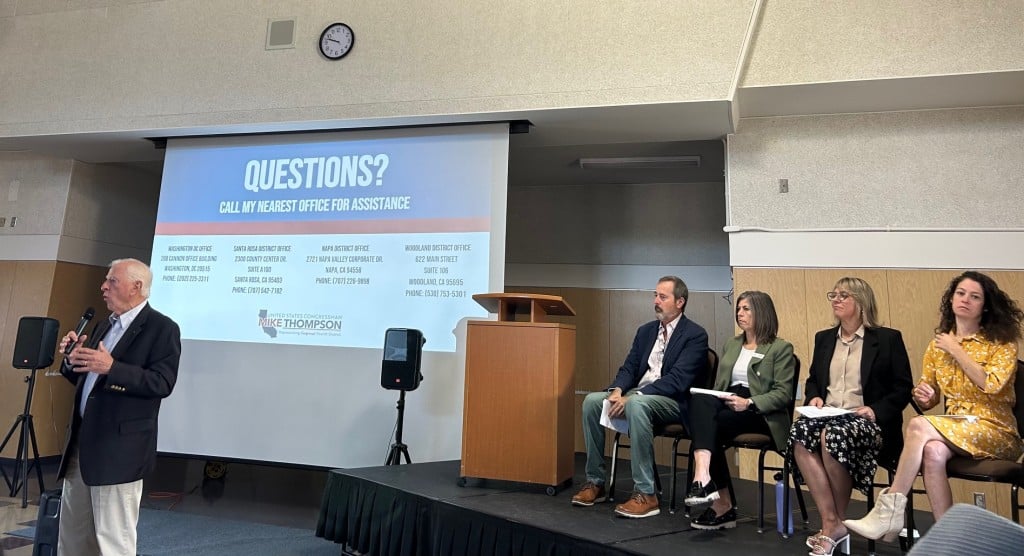
These were among the questions addressed Friday before more than 100 people who gathered at Yountville Commons for a forum focusing on immigration policies.
The event, “Supporting Immigrant Employees,” was sponsored by the Napa Valley Community Foundation with support from U.S. Rep. Mike Thompson, D-St. Helena, whose office has been flooded with questions from employers asking how to protect workers from immigration enforcement raids.
Alissa Abdo, executive director of On The Move, gave a number of tips, including:
- Establish clear policies and procedures in dealing with the U.S. Immigration and Customs Enforcement.
- Designate and mark “private” spaces –– areas restricted to staff. Law enforcement need a judicial warrant to enter these areas marked “private.”
“The goal is not to resist law enforcement, but to ensure due process and avoid unnecessary exposure for your employee,” Abdo said.
- Employees should know their rights. They are not required to answer questions about immigration status, birthplace or how they entered the country. They also do not have to hand over documentation. Workers have the right to seek counsel.
- Call the North Bay Rapid Response Network at 707-800-4544 for help with immigration enforcement. Know resources such as napavalleytogether.org/.
Another speaker, Madeline Hernandez, North Bay regional directing attorney for Immigration Institute of the Bay Area, said employers should designate a foreman who is a U.S. citizen to address ICE agents in case they show up at a vineyard.
Thompson, who stressed his office is there to help, said immigrants contribute “greatly to our communities at every level.”
A University of Michigan study showed that if the Trump administration deports all the people they plan to deport, manufacturers and other employers across the country will not have the employees they need to do the job that they need to do, Thompson said.
“And secondary to that, the folks that this administration wants to deport and send away, they’re consumers,” Thompson said.
Undocumented immigrants contribute more than $25 billion a year to fund Social Security, which is also under attack by the Trump administration, Thompson said. Undocumented immigrants are not eligible to receive Social Security.
In addition, the Trump administration’s policies could worsen the K-12 teacher shortage by 6,000 teachers, Thompson also noted. About 6,000 “DACA” recipients –– young immigrants eligible to stay in the U.S. under the “Deferred Action for Childhood Arrivals” program — are K-12 teachers.
“This is not good public policy. It’s not being a good human being. It’s not ethical. It’s not moral. We need to fix the immigration problems that we have, but we need to acknowledge and celebrate our immigrant population,” Thompson said.
The Napa Valley Community Foundation, a member of Napa Valley Together, has worked on immigration issues for years.
“Without our immigrant community, our economy would fail,” Napa Valley Community Foundation president and CEO Terence Mulligan said shortly after the 90-minute symposium ended. “The twin engines of Napa’s economy are viticulture and hospitality. And immigrants are overrepresented in those sectors. We feel a moral duty to do everything that we can to try to help.”
The Napa Valley Community Foundation has helped immigrants seeking citizenship and other services for years. The nonprofit organization has put more than $3 million into that effort since 2012.
The foundation recently increased its financial contributions to support organizations that help immigrants in the Napa Valley. A year ago, that commitment was $200,000 a year, Mulligan said. The foundation now has pledged to raise $500,000 annually for organizations such as Immigration Institute of the Bay Area, On The Move, Puertas Abiertas and UpValley Family Centers. That covers a little more than 20% of their budgets, Mulligan said.
Hernandez also gave updates on immigration-related policy changes.
Individuals are retreating in the shadows instead of seeking services they could qualify for, including immigration and legal services, Hernandez said. “The fear, the anxiety is real,” she said.
That’s why it is important to work together, Hernandez said, referring to organizations that provide legal, family and other services.
While ICE agents have been present in Napa County, there have not been large, targeted raids, Hernandez said.
There are also new barriers for paths to U.S. citizenship, including a test of “good moral character.” There are also additional questions on the citizenship exam and in the oral interview.
Citizenship provides an extra layer of protection, Hernandez said. “This sort of additional barrier to us is very intentional.”
Hernandez said the Trump administration has decided to deport people who have committed no crimes, who have lived in the U.S. for decades, have contributed to the economy, are part of the community and who have family members who are U.S. citizens.
Other decisions have affected thousands of would-be immigrants. Earlier this year, about 30,000 asylum seekers lost their right to have an interview to enter the U.S. The administration also has attacked the humanitarian program that gives Temporary Protected Status to thousands of immigrants from countries such as Syria and Venezuela.
Napa Valley Community Foundation board member Pete Richmond, who owns and runs Silverado Farming Company, urged attendees to support the nonprofit organizations present at Friday’s symposium.
UpValley Family Centers helps clients gain access to various services, including low-cost legal services and free civics instruction to prepare for the citizenship exam. The nonprofit organization also prepares families in case a loved one is deported and provides employers and others with accurate information on immigration-related matters.
UpValley Family Centers also leads workshops on immigrants’ rights and other topics, including how to differentiate local law enforcement from ICE agents.
Since 2013, UpValley Family Centers has helped more than 8,000 people with either citizenship or other U.S. applications. More than 134,000 people have received citizenship-related information.
UpValley Family Centers now works with the Napa Valley Community Leaders coalition on civic engagement advocacy to spur policy change.
“So, we’re looking at this as a comprehensive effort to support our community,” said Jenny Ocon, UpValley Family Centers’ executive director.
Thompson said he was pleased with Friday ‘s turnout. People care about their neighbors. “It just shows how great our community is,” he said.
He remains perturbed by the current administration. “It’s chaos created by this president and his administration,” Thompson said after the session. “And it’s particularly harmful to human beings. And that bothers me a great deal.”