Museum on wheels encourages Calistoga youth to speak up
The first thing Ze’Nyjah Zalenski noticed in grainy footage from 1930s Germany was a group of people scrubbing a street on hands and knees while others looked on.
“It kind of made me sick to my stomach,” said Zalenski, a student at Calistoga Junior-Senior High School. The footage showed followers of the burgeoning Nazi regime forcing their Jewish neighbors into acts of public humiliation.
‘We didn’t know we had so much power,’ said student Hania Cortez
“They treated them like animals,” she said. “All of them are the same — but they take a religion and say, ‘You’re not human.’”
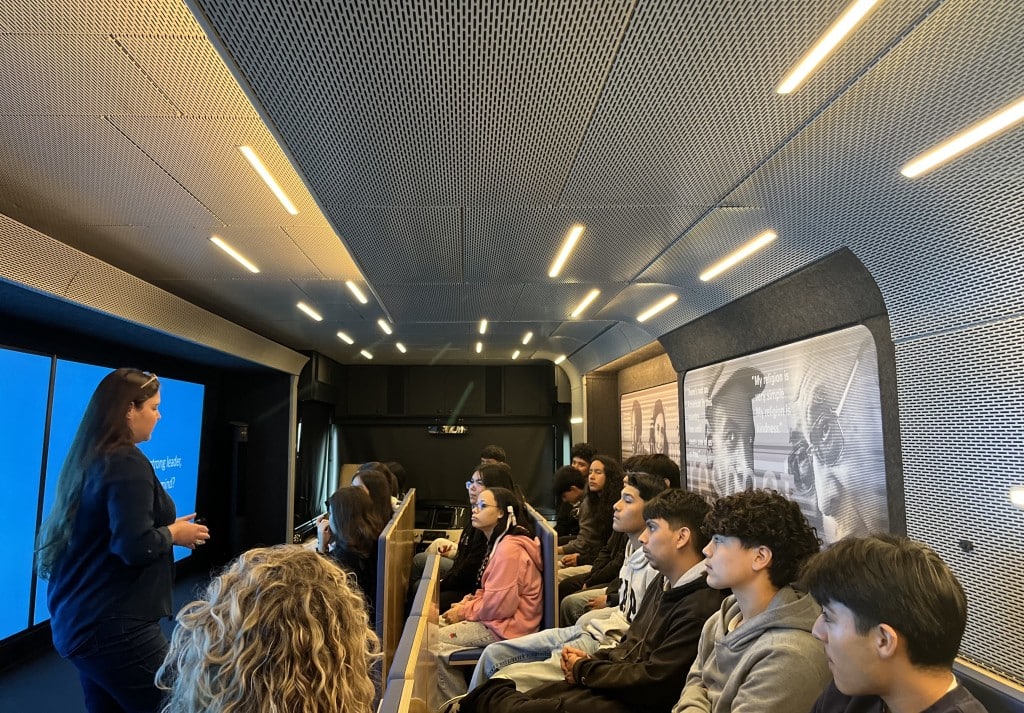
Zalenski and some 20 others from Kirstin De La Cruz’s 9th and 10th grade English class were taking part in a series of workshops in the Mobile Museum of Tolerance, a tour bus-sized version of its Los Angeles namesake.
From March 30 to April 1, the mobile museum was stationed in front of Calistoga Junior-Senior High School, where educators Ewa Geisler and Cecilia Mejia held four daily workshops on recognizing and resisting the power of hate from Nazi Germany to the present.
“The initiative is to go around California and bring the museum to the students who can’t come to LA,” said Geisler, a former elementary school teacher.
Tuesday afternoon’s workshop was “The Power of Ordinary People,” which walked students through the ways Nazi propaganda led to the Holocaust.
The Museum of Tolerance was founded in 1993 to encourage learning as an antidote to discrimination. “It’s a broad definition of tolerance,” said Geisler. “But essentially, it’s about accepting people who are different from you.” Now, she added, these lessons are more important than ever.
Before their stop in Calistoga, Geisler and Mejia had been on the road since September 2025, visiting schools in the Bay Area, Fresno, San Diego, El Centro, Santa Cruz and in nearby Sonoma County. The mobile museum is free to host but requires schools to go through an application process.
Among the lessons offered to Calistoga students were “The Anne Frank Story,” “Civil Rights,” which goes through the struggles and work of Black Americans from the 1960s up to the present Black Lives Matter movement, and “Combat Hate: A Digital Media Literacy Workshop,” Geisler’s personal favorite. “We talk to students about social media, the effects of seeing online hate every day and how we can cope with that,” she said.
Walking out of the mobile museum, student Sebastian Mendoza said he was impressed by how much an individual could do in confronting injustice. Part of the workshop covered the work of anti-Nazi activists like Sophie Scholl, a Hitler Youth member who turned on the party and was later killed for her outspoken critique of Nazism.
“These people who stood up, they made an impact,” said Mendoza. “The family that helped Anne Frank? Incredible. They stood up for what they thought, even though it could’ve gotten them killed. I love that.”
After the workshop, high schoolers acknowledged similarities between the beginnings of Nazi Germany and present-day United States, where Immigrations and Customs Enforcement (ICE) is targeting and imprisoning immigrants, mostly people of color.
“I see a lot of parallels [to today],” said Mendoza. “Not even with big politicians — with regular people who stand up.”
Some 90% of the school’s 360-odd students are Latine, said English teacher Jessica Musser, who spearheaded the effort to get the Mobile Museum of Tolerance to Calistoga. Throughout the past year, Calistoga students have been showing up in droves to protest mass arrests by ICE.
“It can be life-altering to realize at this young of an age that your voice does matter,” she said. In class, Musser welcomes students to engage in tough topics, teaching “The Diary of Anne Frank” and “The Devil’s Arithmetic” and discussing Israel’s ongoing destruction of Palestine.
“I talk about what’s happening and genocide that still occurs,” said Musser. “And recognizing that anybody can be corrupted by power.”