Napa County’s historic hot springs

Tribune File Image by Joan Martens
The Sharpsteen Museum in Calistoga holds a wealth of fascinating, often little-known history, ranging from works by the museum’s namesake artist, Ben Sharpsteen, who created animation for Walt Disney, to numerous railroad and stagecoach exhibits, to one of the remaining authentic homes of the late 1800s, which is attached to the museum.
The museum is running its exhibit titled Destination Napa: Philosophies of Wellness through May. In partnership with the Napa County Historical Society, it presents research, photographs and historic objects showing that Calistoga was not the only Napa Valley town with mineral springs and resorts.
Before the wine industry proliferated across Napa County’s pastoral landscape, the rich volcanic history of the region provided natural geothermal hot springs that were used by the indigenous Wappo people.
Fast forward to the 1850s and the beginnings of today’s wellness industry when tourists and locals alike flocked to the valley’s natural hot springs resorts and wellness retreats to “take the waters,” from natural springs that dotted the valley from the Mayacamas Mountains to the Vaca range.
Hot spring resorts, with their alleged curative properties, were like a magnet drawing people to Napa County since the time of Sam Brannan, the entrepreneur credited with naming the city of Calistoga. Lore has it, he drunkenly combined the name of the famous Saratoga Springs, New York resort town with California when he opened Brannan’s Cottages in 1862.
“I’m going to make it the Calistoga of Sarafornia!” the 19th century business mogul is said to have exclaimed.
In addition to providing rejuvenating bathing, the mineral-dense waters were also carbonated and bottled, touted for their curative properties. Some hot springs establishments even published the chemistry of their waters.
With more than 240 documented resorts and hotels between 1852 and the 1920s, there was an establishment for everyone from wealthy patrons to military men, and even those involved in the temperance movement. The industry drove the local economy.
Advertising of the time claimed that Napa’s fresh air and the curative properties of the various springs, along with bucolic views, equaled health and vigor for all who visited. Mud baths, “medicines” concocted with mineral waters, soaking in said waters, bottled carbonated mineral water and first-rate gastronomy were offered across the county.
White Sulphur Springs
White Sulphur Springs, California’s oldest springs resort, founded in 1852, was located on 640 acres along White Sulphur Springs Road west of St. Helena. The springs varied in mineral content and offered healing powers, cures and relief from various maladies.
The waters were described in an 1873 survey by the California Department of Public Health as containing carbonate of lime, carbonate of magnesium, sulfate of soda, chlorides of sodium and calcium, carbonate of magnesia, as well as sulfides of sodium and calcium, with temperature ranges between 64.4 degrees F to 97.25 F.
To reach White Sulphur Springs, San Franciscans made the trip by steamer across the bay to Soscol Landing, four miles south of Napa. Next, they boarded a train, and finally a stagecoach delivered them to the resort.
Managed by Swen Alstrom from Sweden, White Sulphur Springs grew to accommodate more than 250 guests.
White Sulphur Springs’ hospitality boasted a dining hall, trails for hiking and a telegraph wire for its business clientele, along with a swimming pool. Word spread regarding the lovely grounds, and the springs gained in popularity with distinguished guests such as Leland Stanford, Stanford University’s founder, writer Ambrose Bierce and Lillie Hitchcock Coit, a patron of San Francisco’s volunteer firefighters who sported men’s attire and smoked cigars while gambling.
The property changed hands many times, morphing from its luxurious retreat to a boys’ camp in 1955, then a Methodist Church, Zionist Youth Commission, and in 2017 a retreat center for the Hoffman Institute.
The facilities have been damaged by several fires, with the latest being the Glass Fire of 2020, with 17 of its 20 buildings left in ruins.
Calistoga Hot Springs
When Sam Brannan, California’s first millionaire, and his wife, Ann Eliza, spent their vacation in 1852 at the White Sulphur Springs Resort in St. Helena, he, as many others, decided that the spa life had much to offer. He snapped up two square miles in what was known as Hot Springs Township, later called Calistoga. Soon Brannan’s holdings ballooned to 2,000 acres, according to Napa County Historical Society’s paper by Kathy Bazzoli of the Sharpsteen Museum.
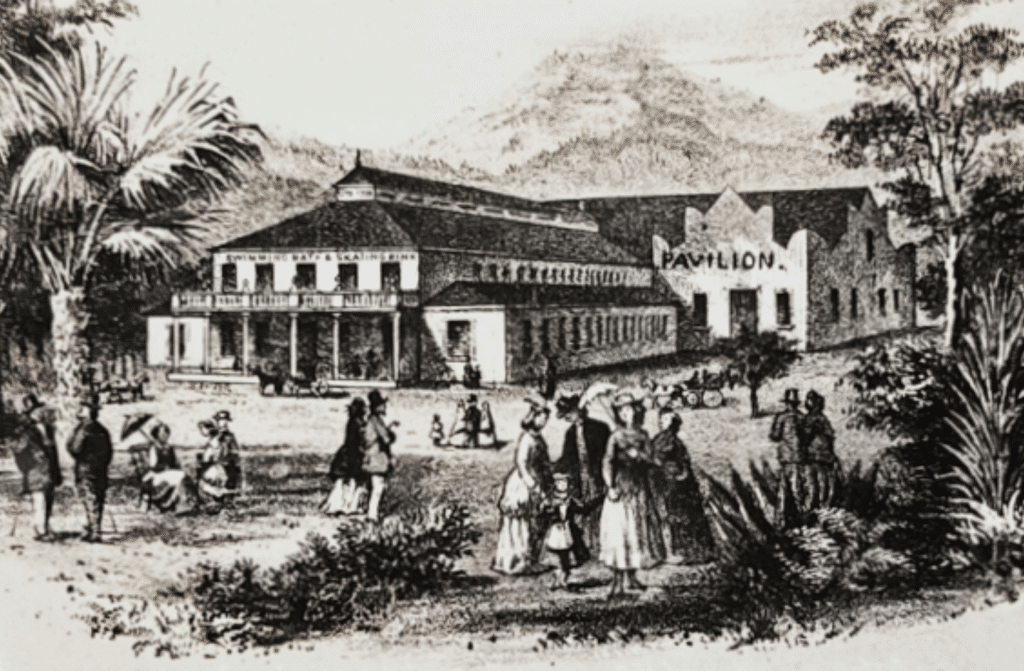
Since Brannan was from the East Coast and familiar with the Saratoga Resorts in New York, he could envision a grand resort of the West. With much elbow grease, he enjoyed a grand opening in 1862 of a resort with dozens of buildings that included 14 cottages all decked out with excellent furnishings and gingerbread trim. His attention to detail was unparalleled, and he drew thousands to his lavishly landscaped grounds, which included parks and a procession of floral-lined streets for guests to traverse.
Accommodations for his guests left nothing to be desired, with a dance pavilion, deluxe skating rink and bathhouse near his elaborate mansion. One could shop at Brannan’s General Store, swim in a lavish pool, gaze at goldfish in a contemplative pond or mosey over to his racetrack and stables of which held not only his steeds but those of the big names of the time such as James Lick, Leland Stanford and William Randolph Hearst.
If soaking in the mineral waters, strolling the park-like avenues, shopping or enjoying the beauty of the Mayacamas Mountain scenery did not pique guests’ interests, then excursions to points of local interest such as the Petrified Forest, the geysers or nearby towns via horseback or buggy could be hired.
When the Brannans suffered a nasty divorce in 1870, the majority of their property in Calistoga was liquefied. Around 1911, the Brannan resort was bought by Jacque Pacheteau who called it Patcheteau’s Hot Springs. Most of the Brannan lands later became what is now Indian Springs Resort.
Napa Soda Springs
In 1856, Amos Buckman purchased land north of Napa and east of the Silverado Trail and constructed a modest hotel that later became Napa Soda Springs. After the property suffered a fire, the springs were used by Charles Henry Allen, who bottled around 300 bottles of soda water per day amidst a property dispute between Buckman and Dr. John Henry Wood. Wood had purchased the springs after he saw the potential healing powers in the waters, but a much-publicized legal battle grew for title to the property, which Wood later lost.
In 1872, Napa Soda Springs was purchased by Colonel John P. Jackson, hence its moniker, Jackson’s Napa Soda Springs. Jackson, a lawyer, president of the Central Pacific Railroad and, later, owner of The San Francisco Daily Evening Post, constructed an opulent resort with ballroom and a splendid rotunda-with-a-view, sometimes called, “Jackson’s Folly” as it cost $80,000 and was initially to be used as stables. Sitting at almost 1,000 feet above sea level, the rotunda afforded views of Mount Tamalpais, Mount Diablo and Mount St. Helena across the valley.
By 1879, Napa Soda Springs had sold, in total, 36,000 bottles of water to local shops and eateries. The resort reopened in 1881. Complete with 27 hot and cold springs bath houses, beautiful paths and gardens, it offered bowling, croquet, horseback riding and bands to accompany the dances.
The resort added considerably to Jackson’s wealth in a short time as word of the elegant retreat spread. In 1890 President Harrison appointed Jackson assistant United States treasurer, and after Harrison’s presidency, Jackson invited Harrison to the springs in 1894.
The clientele began to dwindle in the early 20th century, then disaster struck in 1913 with a devastating fire damaging several buildings. Jackson’s son ran the establishment until another fire damaged both the rotunda and the bottling facility in 1944. A third fire in the 1960s brought the structures to further ruin.
In 2022, Restoration Hardware purchased the 856-acre Napa Soda Springs property with hopes of bringing back the castle-like rotunda, in addition to a guest house, residences and a winery.
Zem Zem Springs
Zem Zem Springs, situated in the Berryessa Valley, was once known as Sulphur Springs Hotel. It underwent a name change when an early visitor exclaimed the waters there were flavored like the water at the holy well of Mecca in Saudi Arabia, called the Zamzam Well.
Geological information from the Napa County Historical Society states that Zem Zem “was perhaps the only source of aragonite, or onyx marble, in Napa County.”
Walter Springs
An 1885 San Francisco Chronicle advertisement stated that Walter Springs had opened. The resort was located about ten miles east of Aetna Springs in Pope Valley on the eastern side of the canyon near Pope Creek.
The advertisement, by G. F. Walter, proprietor of Pope Valley’s Walter’s Soda Springs, stated, “Now open for guests, the most elegant family resort; the medicinal properties of these waters are not surpassed by any in the state.”
The 1915 book, “Springs of California,” says the resort was renovated around 1902, and by 1910 could accommodate 50 guests and included a pavilion for socializing and dancing. Spring waters were bottled and marketed and were said to taste “distinctly sweet,” due to the high magnesium content.
Bothe Brothers Paradise Park
Another draw to the Napa Valley, according to the St. Helena Historical Society, was Bothe Brothers Paradise Park, a resort constructed by brothers Reinhold and Jeanne Bothe halfway between Calistoga and St. Helena.
Although technically not hot springs, since the resort’s spring-fed water came from Ritchey Creek, Bothe was still a popular wellness destination. Established in 1929 the resort was situated on 1,200 forested acres, the sites of modern-day Bothe Napa Valley State Park and the first church in Napa Valley, which was founded by Pastor Asa White of the Donner Party.
The resort closed during World War II, then was reopened by the Bothe brothers in March 1949. One of the resort’s 1952 menus offered entrees of freshly ground continental steak for $1.25, choice filet mignon steak for $2.50 and one-half of a fried Hampshire red chicken for $1.50. Other fare included salads, desserts and sandwiches.
The resort was sold and became a California State Park in July 1960.
Hot springs around the world were in vogue historically at the same time as Napa’s heyday, from famed Bad Ems baths of Germany, still operating today, to Arkansas Hot Springs to New York’s Saratoga. Sonoma and Lake counties also both had thriving springs retreats.
Early visitors to the luxurious lodgings in the Napa Valley traveled by stagecoach, train and eventually automobile to experience the beauty of nature, replete with a refreshing climate and therapeutic mineral springs. The advent of travel by automobile altered the future of hot springs as a destination, since so many other options opened up to tourists.
The resort industry may have shifted over time, but the benefits of Napa Valley’s climate and magical vistas still draw visitors from afar.