Resources without restriction in Napa County: A safe haven for all
Lee esta historia en español y más noticias locales, suscríbete a nuestro boletín Conéctate Napa County.
In Napa County, declarations of solidarity with immigrant communities are plentiful. Local police departments and city officials have pledged their support through statements and symbolic gestures, but as California state leaders prepare to scale back lifeline services, the burden falls increasingly on local nonprofits to sustain safety nets for its most vulnerable community members.
Gov. Gavin Newsom recently proposed halting new enrollment of low-income immigrants without legal status into the state’s Medi-Cal program starting in 2026, as well as charging monthly premiums to those already covered by 2027. The reversal comes just a year after California became one of the first states to offer state-funded health care to all income-eligible adults, regardless of immigration status, a major step toward universal coverage.
Against this backdrop, a growing network of grassroots organizations across Napa Valley are working to fill the gap. From mental health counseling and mobile clinics to culturally competent legal navigation and wraparound services, they’re providing essential support regardless of immigration status.
Here’s a look at the organizations ensuring that dignity, safety and critical services remain within reach for all.
Mentis Napa: Bilingual mental health counseling and behavioral services to clients of all ages, backgrounds, languages, income and immigration statuses.
“We don’t ask anyone about their immigration status and never record this information anywhere,” Charlotte Hajer, PhD, development director at Mentis said in an interview with Napa Valley News Group. “We are doing everything we can to ensure that undocumented clients and anyone else who might be targeted by ICE feels safe with us, including through telehealth appointment options.”
About half of their clinicians are bilingual in English and Spanish, and many are bicultural, said Hajer, emphasizing the need for not just language access but also shared cultural understanding.
For other languages, Mentis ensures access through interpretation services, Hajer said.
St. Helena Hospital Foundation and Napa Valley Grapegrowers: On-site health services for the agricultural workforce.
Earlier this year, The Napa Valley Grapegrowers partnered with the St. Helena Hospital Foundation to expand preventative health care services for agricultural workers across the county.
The program’s mobile model ensures services reach laborers directly in the fields regardless of insurance or immigration status.
The initiative brings Adventist Health’s Mobile Health Program directly to vineyards, management companies and wineries. Offered at no cost, services include blood pressure, glucose and arrhythmia screenings, Galleri early cancer detection testing, health education and resource navigation.
“Our agricultural workers are the backbone of this region, and their health is essential to the strength of our community,” said Glen Newhart, president and CEO of St. Helena Hospital Foundation. “Through this partnership, we are removing obstacles to care and ensuring that essential health services are delivered directly to the people who are so vital to our community.”
The partnership was shaped in response to St. Helena’s Community Health Needs Assessment, which revealed a widespread lack of awareness around how to access care, especially in rural immigrant communities.
CommuniCare + OLE Health: As a federally qualified community health center, the provider with more than 17 sites across Napa, Solano and Yolo counties offers sliding-scale or free primary care, dental, pediatric and mental health services.
“No one is turned away due to lack of insurance, immigration status, or ability to pay,” according to the provider’s website.
The organization’s newest spokesperson did not respond to repeated requests for comment over a two-week period.
Immigration Institute of the Bay Area: The largest nonprofit provider of immigration legal services in Northern California has seven offices in six counties.
The Immigration Institute of the Bay Area (IIBA) Napa branch plays a key role in the region’s safety net, particularly by offering affordable, community-based legal aid in both Spanish and English, with interpretation available for additional languages.
IIBA staff assists with a wide range of immigration matters, including DACA renewals, green card applications, family petitions, U visas for victims of crime and Temporary Protected Status (TPS). The organization also hosts monthly citizenship workshops and offers free naturalization classes to help lawful permanent residents take the next step toward U.S. citizenship.
As immigration policy remains in flux nationwide, IIBA leaders are urging local residents to stay informed and prepared for enforcement actions that could soon expand beyond major metro areas.
“The ability to replicate what’s been done in Los Angeles and Southern California in other parts of the country is very real,” said Juan Ortiz, co-regional directing attorney of the nonprofit. “Everyone should be informed about how to improve their legal status or, if they don’t have one, to understand their rights and how to protect themselves and their families in the event of detention.”
By reducing fear and confusion around the legal system, IIBA helps immigrants make informed decisions about their future and assert their rights in a shifting landscape.
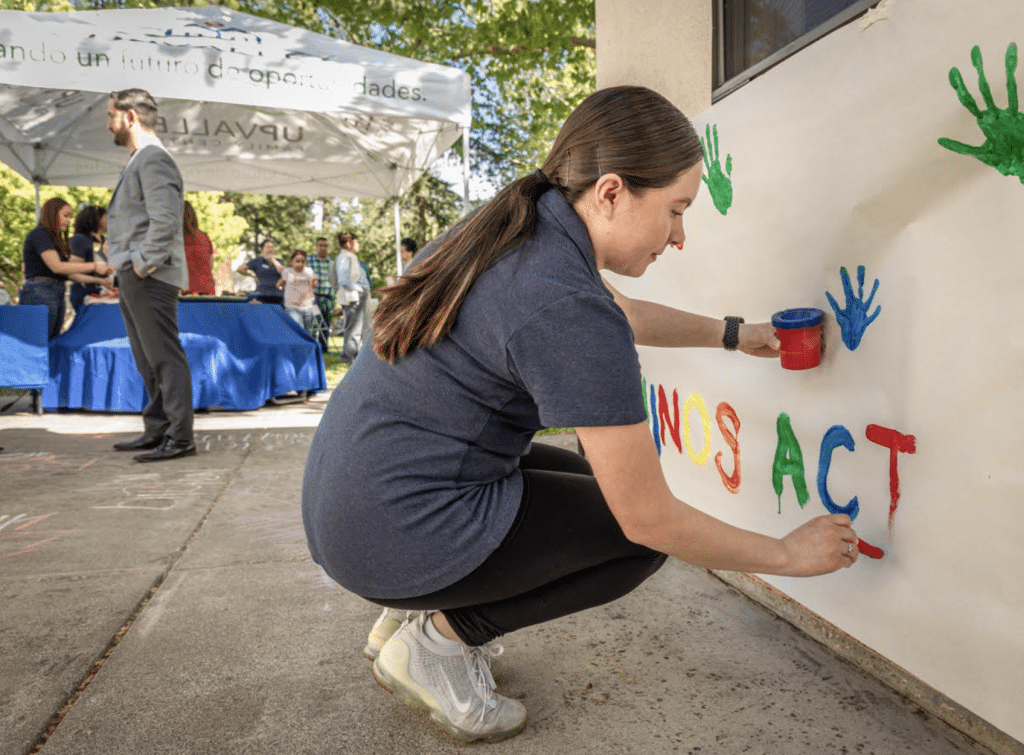
UpValley Family Centers: A bilingual nonprofit community resource center offering immigration assistance, early learning and family support regardless of income or status.
Operating resource hubs in Calistoga and St. Helena, UpValley Family Centers supports northern Napa County’s rural and often underserved populations.
The center offers a wide range of services for children, youth, families, adults and older adults, including early learning programs, youth mentorship, immigration services, tax preparation, financial coaching, caregiving and disaster preparedness.
“As a nonprofit, we’re often the first place people turn for help. A lot of times going into a government building can be intimidating for people,” Executive Director Jenny Ocon told Napa Valley News Group. “As a nonprofit, we rely entirely on community support to keep doing this work and serving those who need us most.”
Notably, they provide guided referrals to healthcare, mental health providers and social services, and their staff helps with Medi-Cal and CalFresh applications. They routinely host Know‑Your‑Rights presentations.
Puertas Abiertas Community Resource Center: Known as a trusted sanctuary and community advocate for Latine and other vulnerable residents of Napa Valley.
Their bilingual, bicultural team provides comprehensive support ranging from legal and immigration guidance to assistance with Medi-Cal, CalFresh, EDD and Social Security. They also offer mental health services, community workshops, youth programs, emergency aid, food assistance and disaster relief.
The organization did not respond to repeated requests for comment over a two-week period.
Napa Valley Together: The local coalition unites Puertas Abiertas with UpValley Family Centers, the Immigration Institute of the Bay Area, On the Move, Community Leaders Coalition and the Napa Valley Community Foundation.
Their work includes offering Know Your Rights workshops, mental health arts and trauma programming, employer training and preparing families for potential ICE actions. The coalition also prompted the County to add immigrant resources to its official site and establish an ad hoc supervisory committee focused on marginalized groups.
We will continue to update this information regularly.