‘The Mender’ – Napa volunteer has spent 31 years preserving library books
For more than three decades, Michael “the Mender” Herzog has been quietly helping keep the shelves of the Napa County Library in working order, one book at a time.
In fact, he knows exactly how long he’s been doing it. Michael keeps a day calendar and recently noticed that his 31st anniversary as a volunteer had just passed.
His work at the library didn’t begin with glue, bindings and a book press though. During the early 1990s, when the library building was undergoing an expansion, Michael spent his first six weeks greeting visitors at the door.
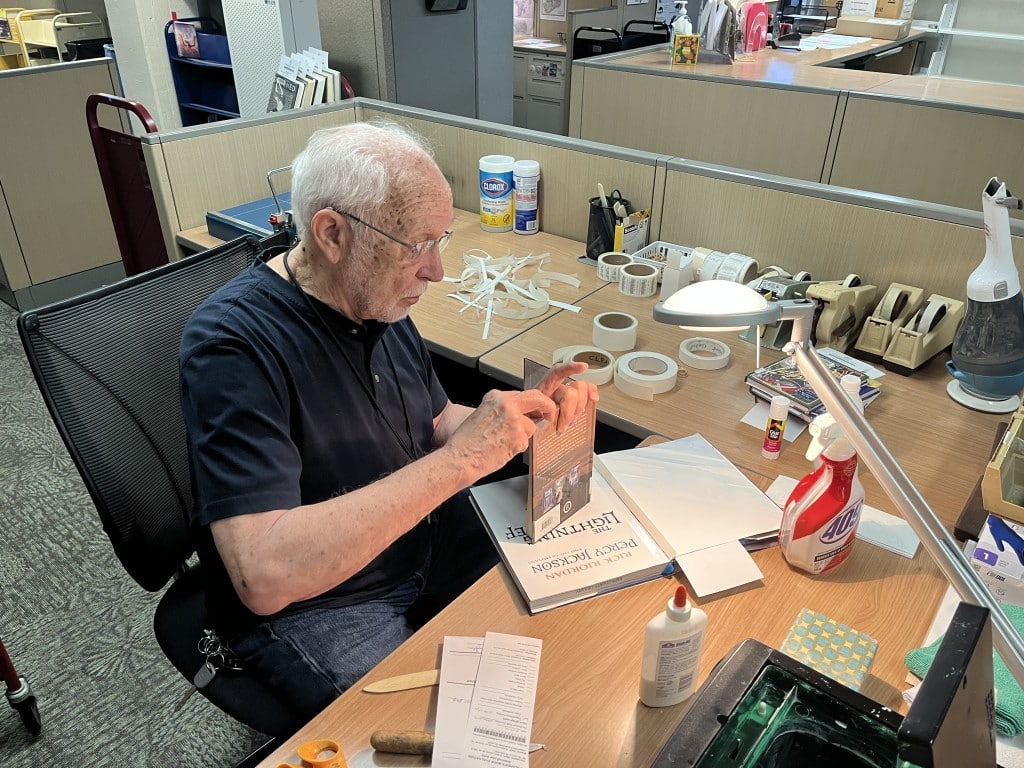
“For the first six weeks or so,” he recalls, he helped welcome patrons during the renovation. The director at the time, Tom Trice, knew that Michael wanted to repair books but didn’t place him in that role initially. By his second month, however, he “went upstairs” and was in the spot that would define his volunteer work for decades: repairing books and other materials.
The Napa County Library is a popular reading library. This means we don’t collect many vintage or valuable items that need to be kept in perpetuity. For the most part, when a book is damaged, worn or simply falls apart, that’s the sign that we need to replace it with a newer release. However, there are some items that a quick fix will bring back to life or we feel add value to the collection and are hard to replace. That’s where Michael fits in.
A mind for structural problems
When asked about the most unusual items he’s repaired, Michael didn’t hesitate:
“I like structural problems,” he says. “You might guess this because I was a chemical engineer, but when books are too heavy to support the binding and fall apart, thinking about how to fix it is something I enjoy.”
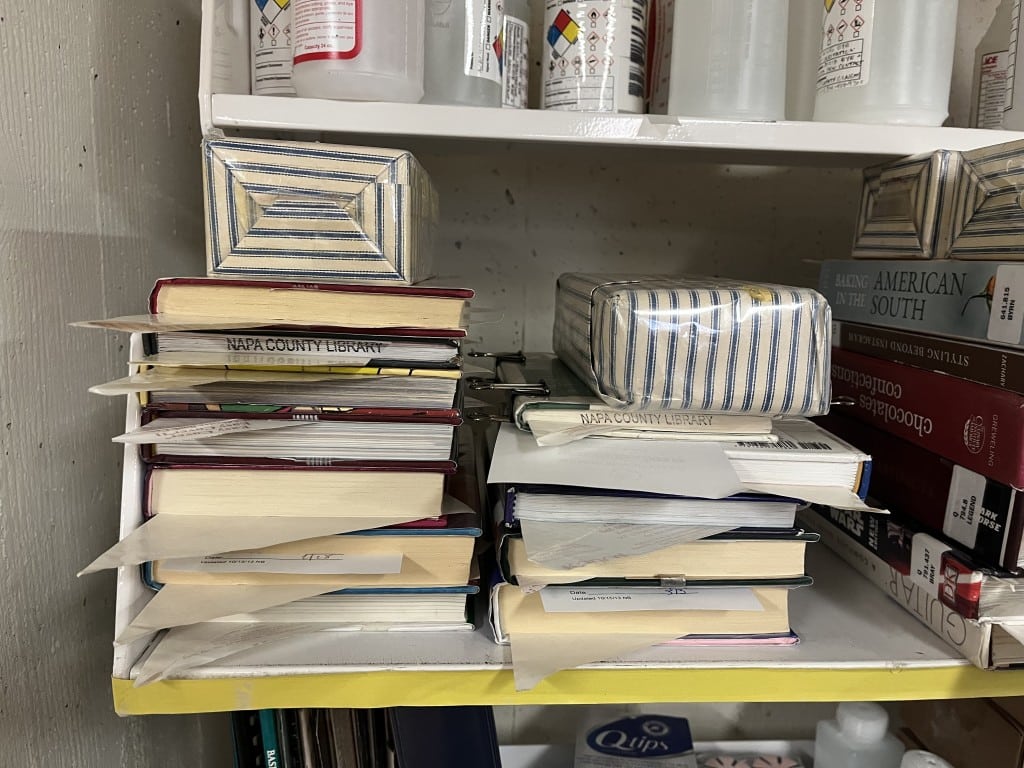
Some repairs require patience that stretches over weeks. “I currently have a book under repair that will take me three weeks since I have to glue it back together in different stages,” he explains.
Travel guides present another kind of puzzle.
“I also like to repair travel books,” he says. “I see a lot of them this time of year as that’s when they are published and when people start thinking about summer vacations.”
Those books often contain extra elements — maps, inserts, and foldouts — that make them particularly difficult.
“Those books are complex because they often have maps or sheets or other items that need to be attached,” he says. “But the book still needs to function—close, have the map accessible, etc.”
Trial and error
Michael didn’t learn book repair in class. His education began years earlier as a young book collector.
“I have a fiction collection of around 2,700 titles,” he says. “As a younger man with limited funds, when I was originally looking for them, I would often seek out titles but needed to buy the cheapest one. That’s how I learned to mend books, through trial and error.”
Today, he doesn’t shop for books as often.
“Now I don’t buy many new books, and I go ‘shopping’ in my own collection.”
His repair work extends beyond the library. He also helps mend books at Shearer Elementary, the Friends of the Napa Library and the Napa Valley Genealogical Society.
When Michael first began volunteering at the library, two experienced menders helped him refine his skills.
“I was trained by two women – Nina and Elda – who were also volunteers,” he recalls. “They showed me the basics.”
Their guidance helped him unlearn some habits he’d developed on his own.
“I learned that much of what I’d been doing to repair my own books wasn’t the best,” he tells me. “For instance, I used masking tape on book bindings. This becomes brittle, aged and can damage pages. But I didn’t know any different.”
Even so, one lesson he learned much earlier still guides his approach.
“I also think about something that my mother taught me when I was working on model airplanes with my brother in the basement,” he says. “She told us, ‘Remember, make sure to pin your work.’”
The advice was simple but lasting.
“That means you need to set things in place before you permanently attach or glue them,” he explains.
The everyday injuries
The most common repairs Michael sees aren’t dramatic; they’re the everyday wear and tear of books that are well loved.
“Books that have pages marked,” he says immediately when asked what comes across his desk most often.
Children’s books are frequent visitors.
“Often children’s books get markings inside of them,” he says. “Children frequently see a blank page as a place to color or draw.”
Fortunately, many of those pages can be removed without affecting the story.
“I can often remove those blank pages [they’re often called ‘end pages’ because they’re at the front or back of a book and don’t have anything printed on them]” he explains. “I can do it now so that you’d never know the page was there.”
Books also return from their adventures with evidence of where they’ve been.
“While we tell people not to get around water with books, I often have ‘beach reads’ come back with sand inside,” Michael says.
Fixing them sometimes means taking the entire book apart.
“I can frequently take the book apart, sift out all the sand, and then reassemble it.”
Over the years he’s tackled a wide variety of unusual repairs: grease-stained car repair manuals (isopropyl alcohol works well, he tells me), warped pages, and bent corners.
“I’ve tackled grease marks on car repair books, ironed bent pages—they never come out perfect, but are often pretty close,” he says.
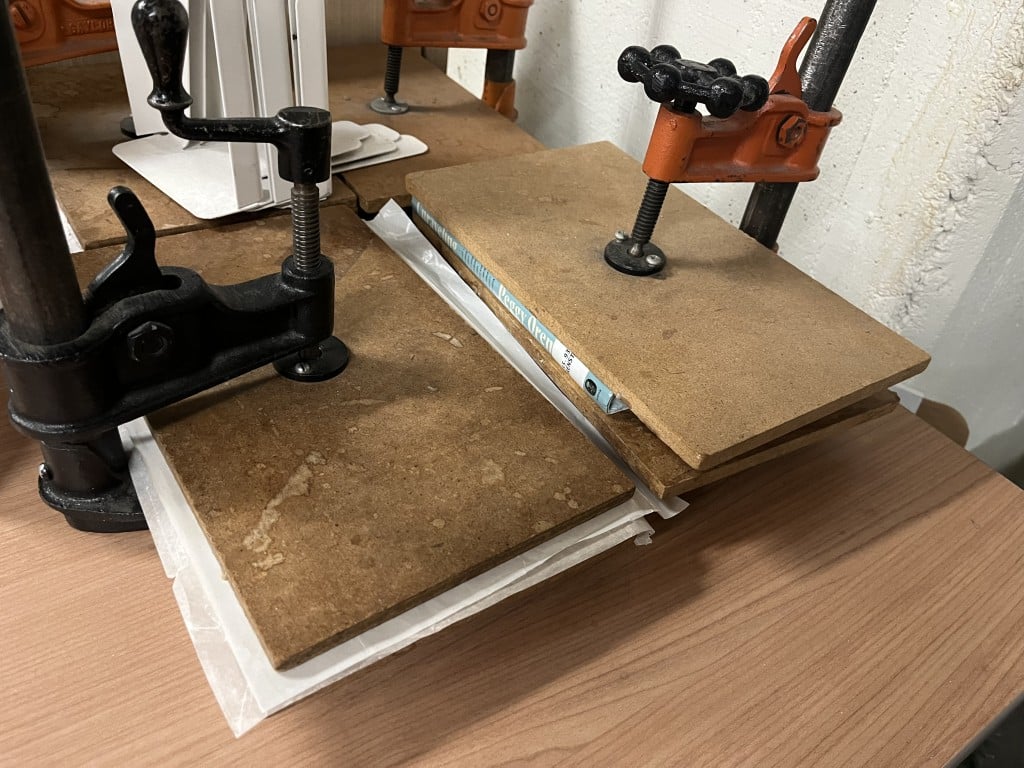
Discoveries along the way
Working at the mending desk also exposes Michael to a steady stream of new titles and authors.
“I often make notes of picture books that I think would be of interest to teachers in my family,” he says. “And I’ll write down names of authors of interest as well.”
In this way, the work of repair becomes an act of discovery.
A quiet legacy
After more than 30 years of volunteering, Michael doesn’t point to any single repair as his proudest accomplishment. Instead, he thinks about the thousands of books he’s helped save.
“I am pleased to think that there are thousands of books that remained available to patrons because of my work,” he says.
For him, the reward is simple but meaningful.
“It’s a privilege to think that I’m helping to share these items with people and that, without my repair, they would not have been able to get access to them.”
His dedication has continued through challenges as well. Michael has kept repairing books through injuries and even during the disruptions of the pandemic.
“I’ve consistently repaired books for the library now for three decades, even when I’d been on crutches,” he says. “Even during Covid, I would meet people at the back door, get supplies and books and then repair them at home.”
I’ve known Michael since I began working at the library more than 15 years ago. Michael is the first face I see when I come in on Monday mornings. He’s at the mending desk, lamp facing down on whatever he’s delicately setting back in place. While his work may not draw a lot of attention, its impact can be found throughout the library’s shelves where each restored book is ready for its next reader.
Napa
The Napa Library is open seven days a week:
Monday – Thursday: 9 a.m. to 8 p.m.
Friday and Saturday: 10 a.m. to 6 p.m.
Sunday 1 p.m. to 5 p.m.
Call the library at (707) 253-4241
Or visit online at www.napalibrary.org/
Yountville
The Yountville Library is open Tuesday to Saturday, 9 a.m. to 5 p.m.
Call the library at (707) 944-1888
Contact the author at Anthony.halstead@countyofnapa.org
Questions or suggestions for the Yountville Library Commissioner: myrnadavid2014@gmail.com
Learn more about Friends of the Yountville Library be reaching out to: yountvillefol@gmail.com
Calistoga
The Calistoga Library is open six days a week:
Monday, Tuesday, Thursday, Friday, Saturday: 9 a.m. to 6 p.m.
Wednesday: Noon to 8 p.m.
Call the library at (707) 942-4833
Or visit online at www.napalibrary.org/
American Canyon
The American Canyon Library is open six days a week:
Monday, Tuesday, Thursday, Friday, Saturday: 9 a.m. to 6 p.m.
Wednesday: Noon to 8 p.m.
Call the library at (707) 644-1136
Or visit online at www.napalibrary.org/