Longhorns Protect Yountville Hill
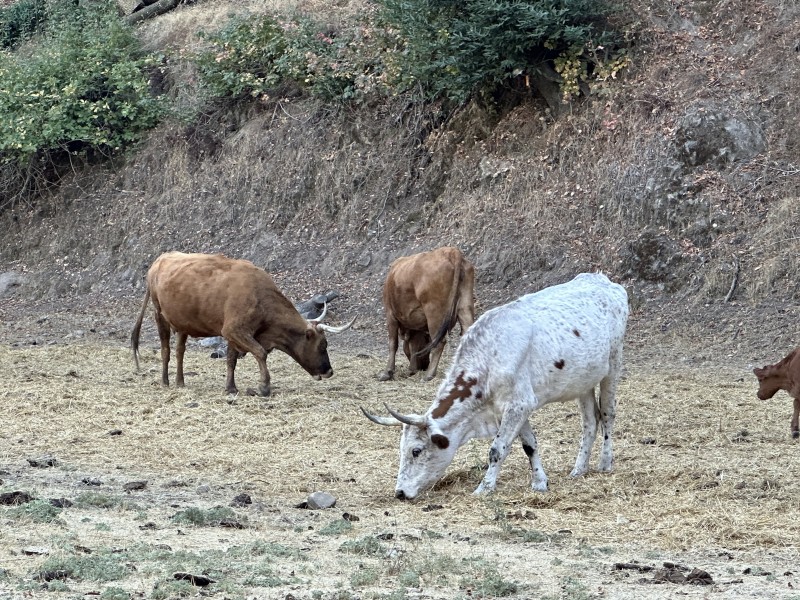
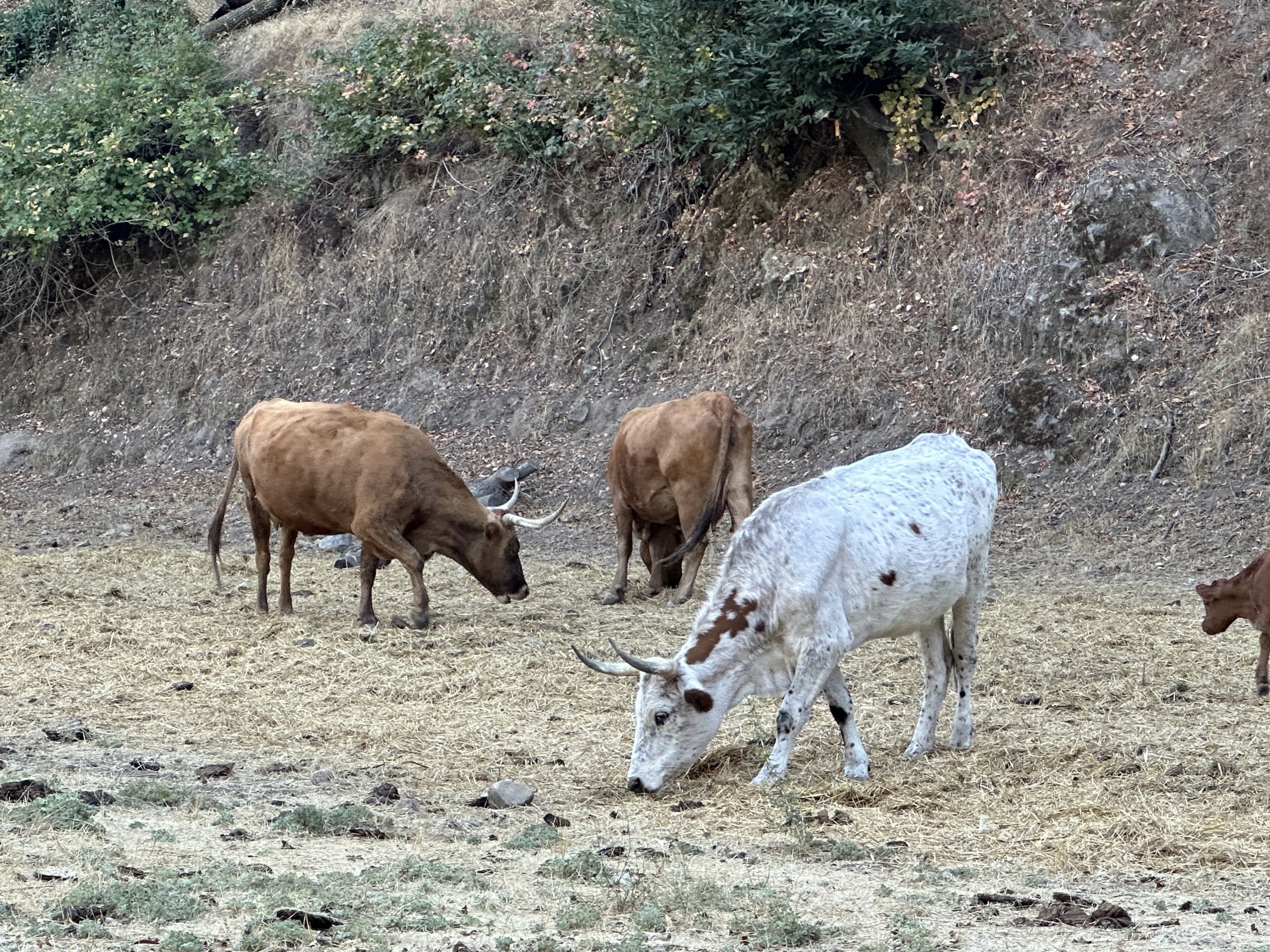
Traveling along Yount Mill Road, the rural, historic and frequently-traveled thoroughfare at the northern town limit of Yountville, it is common to encounter cyclists, walkers and longhorn cattle.
What? Longhorns in Yountville? Likely, George C. Yount, the pioneering namesake of the town, would also have been surprised.
Directly across from the historical marker of the 1836-era Yount Blockhouse, stands the frame of an antique barn, as well as a pasture at the base of the northern Yountville Hill, a place popular with the long-established Yountville longhorn cattle herd that congregates nearby. The herd is also extremely popular with locals who frequent the road, interacting from a safe distance with the animals, often naming them, taking photographs and talking to them from the side of the road.
It may seem unusual, as longhorns are typically associated with far-away places. Yet, these lengthy-horned bovines were selected for this site, as they have an important job.
“The longhorns are specifically there to keep the grass down, so that we don’t have a fire going into Yountville, we use them for fire mitigation,” said Andrew Hoxsey, managing partner of Pelissa Hale Enterprises, the family-owned company that shepherds the herd. He explained that decades ago there were frequent fires on the hill, but there has not been a fire since the longhorns moved into the neighborhood thirty years ago. “In ‘17 and ‘20 we had serious wildfires and we didn’t have one in our particular part of the county.”
In October of 2023, Hoxsey’s family celebrated their 120th harvest in the Napa Valley, marking 1903 which was the year that his Great-grandfather Pelissa harvested 45 tons of fruit near Calistoga. Hoxsey’s grandfather then moved off the family’s Calistoga farm and began farming near Yountville in the early 1930s. The Sullinger House which is now Nickle & Nickle Winery, is where his grandmother was raised. His grandfather ultimately went into business with his father-in-law, Hoxsey’s great-grandfather John Hale. All along, the Pelissa side of the family owned a cattle operation in northeastern California.
While Hoxsey attended nursery school and kindergarten in Rutherford, when he was in first grade his parents moved up to the cattle ranch in Modoc County, which is where he spent most of his childhood. He finished high school, moved on to graduate from UC Davis in 1978, then returned to the family’s Napa Valley farm. Service in the Air Force again took him away from the valley for a few years, before his long family history and local roots drew him back to the farm to manage the businesses in 1984.
Today, Pelissa Hale Enterprises includes Yount Mill Vineyards (a vineyard management and farming company) as well as Napa Wine Company in Oakville. Many generations of Hoxsey’s family remain involved in the businesses, carrying on the Pelissa and Hale family traditions, including his mother Dawne Pelissa Dickenson, Ren and Marilyn Harris (his uncle and aunt), as well as his two daughters.
Three quarters of Yountville Hill is owned by the family, in total about 400 acres. “We own all of the hill that does not have a structure on it. We do not own the northwest portion,” said Hoxsey, describing the unowned area as properties owned by other parties such as the Jones family and Del Dotto.
The Yountville longhorns, make the mostly steep 400 acres of the hill their home. A sustainable and useful crew, they are very low maintenance and remain right in line with the family’s long commitment to organic farming and stewardship of the land.
“The way we originally got the longhorns, we had a little over 1,000 head of cattle on the Modoc Ranch,” Hoxsey explained, adding that the most difficult part of the operation was adequately calving a good percentage of replacement calves. All cattle can age out, usually around the age of ten, and Hoxey said that of 1,000 cattle, you probably need to have 100 calves born each year.
While the family sold the cattle ranch about 20 years ago, they kept the longhorns solely for fire prevention. Yet, the same principles of adequately calving apply with the smaller 40 head of longhorn that work the hill in Yountville. Generally, there are about 36 heifers and four bulls; every year four or five heifers will not calve. They are replaced with young calves from the herd. Members of the herd that age out of the program are usually sold to other ranches as the season moves on and the grasses decrease, some move on to work in rodeos.
October through April is generally the best season for grazing, as by the end of summer the grass has all dried up. “We have virtually no grass in August and September. But they are hearty, they do fine. But we do supplement with hay this time of year,” he said and the resourceful herd is deft at finding other foliage to consume, such as poison oak. During the drought years, the size of the herd is kept to the maximum of 40, and additional hay is used to make sure that the longhorns remain healthy and can do their job.
With the active grazing season coming up, Mother Nature plays a role in the regeneration of the herd. “It’s a nine-month gestation period for longhorns, but in my experience they typically have calves in sync with grazing, they are dropping calves right now in anticipation of the good green grass. Most drop in September as there is good feed in October, November, December and January all the way to April or May,” said Hoxsey, “The calf does well, the cow does well, they rebreed and do it all over again in a nine-month cycle.” There are many recently-born calves with their mothers roaming the hill right now.
Unpopular as beef cattle, the longhorns are known for having a smaller head, making birthing relatively easy. “I have not known them to be belligerent, but those horns are certainly formidable weapons. Their horns can do a lot of damage,” Hoxsey reports, “The length of the horns, when they quickly move their head, it hurts, I can tell you!”
People that see this special herd sometimes worry that a mother is birthing her calf all alone, or that a member of the herd is starving, which leads to unnecessary calls. Hoxsey assures that the family knows what they are doing in terms of caring for this herd. A full-time ranch hand who grew up on a cattle ranch, just like Hoxey, keeps a close eye. “Cows have been having calves in the middle of a field for centuries.”
“We are doing it as simply as we possibly can, it is meant to be very low maintenance,” Hoxsey concluded, “They are as maintenance free as any herd on the planet. We don’t have to do much, they take care of themselves. That’s the reason we continue to raise the longhorns, you can only imagine what 400 acres would look like if we didn’t have them. It is a pretty natural process, with Mother Nature working for herself, with us peering over the fence and making sure that nothing is out of skew. We love to see them about, they are just part of what we do. Longhorns, while you see them a lot in Texas, are not too common around here.”