Napa’s probation on wheels brings snacks, clothes and POs to clients
“You need food if you’re going to think about getting through probation”
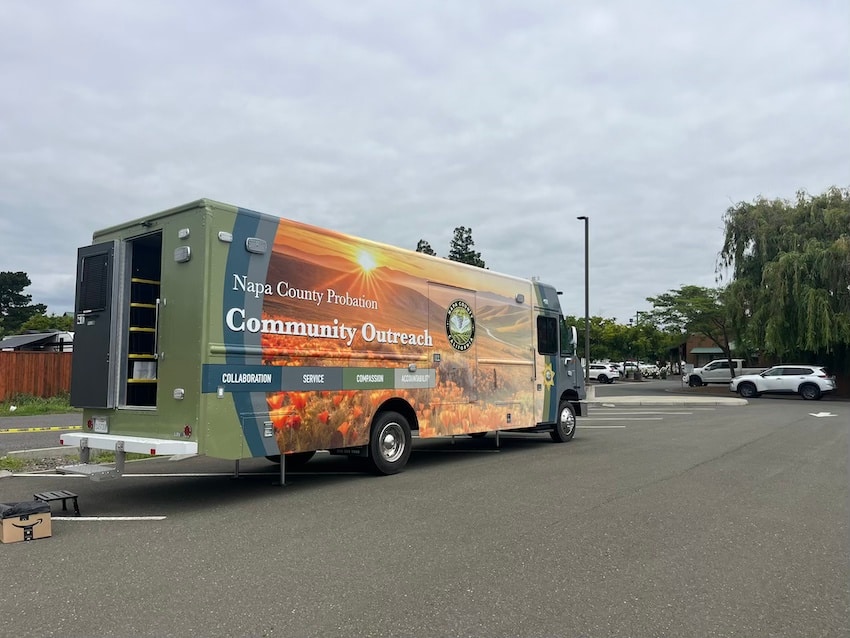
On a sunny afternoon, a friend dropped Eric Batz off outside the American Canyon Library, where the RV-sized Napa County Probation Community Outreach van is parked the first Wednesday of every month from 10 a.m. to 2 p.m.
There’s a saying: “Come to Napa on vacation, leave on probation.” It’s not totally off base — the county is known to hand out tougher penalties than its neighbors, and in 2021, Napa County was the fourth highest spender on jail and arrests out of all 58 counties in California.
In October, Batz will finish serving a four-year probation term for grand theft in Napa County. Batz, now in his mid-50s, has mobility issues and uses a rolling walker to get around. Since the probation van was rolled out last October, Batz has had an easier time making appointments. Missing the court-ordered appointments can result in probation violations — and a trip to jail.
“It’s good,” Batz said. Before the mobile probation office rolled out, appointments were only held at the probation office in Napa. “It’s hard to get there if you don’t have money and you’re disabled,” he said.
The probation office acquired the van with a $463,000 grant from the California Board of State and Community Corrections, with the goal of better serving some 1,800 probationers — specifically, people with disabilities and people without stable homes. Every Wednesday, the van is parked in a different city, with probation officers seeing clients in American Canyon, Napa, Yountville, St. Helena and Calistoga.
“We’ve seen 140 clients over all our locations from American Canyon to Calistoga,” said Amanda Gibbs, chief probation officer for the county.
Of the van’s 140 clients, 112 are men, 26 are women, and 2 declined to state. Racial demographics reflect those in Napa County Jail: 45% of probationers are Latino, 40% white, 6% Black, 4% Native and 5% Asian, Pacific Islander or other.
So far, they’ve only collected data from February to May, but hope to have more by the one-year mark. “The priority was to serve the unhoused population,” noted Gibbs. As of now, there are no data on unhoused probationers.
For Gibbs and her team, the mobile office exists not only to meet clients where they are — literally — but also to emphasize that they’re here to help, not to arrest.
A lot of clients prefer the van, said a probation officer at the van last Wednesday. The emphasis on service over enforcement goes a long way. “We have a more welcoming vibe here,” said the officer. “I don’t have my gun.”
The team’s Wednesdays at the Napa County Library are their busiest, said an officer who spoke to the Current on condition of anonymity. The city of Napa is home to a majority of the county’s 400-odd homeless people, and a number of them are in the midst of court cases.
“Probation as a whole has really turned in the last 20 years,” said Gibbs. She started with the county in 2009. “When I got hired, probation was very enforcement-oriented.” According to Gibbs, Napa was among the first counties in California that moved to evidence-based practices in 2004, which aim to reduce repeat jail visits.
“We all have habits we need to work on,” said Gibbs. “My job is really to advocate for our clients.” Part of that, she said, means ensuring clients’ basic needs are met. The van also operates as a micro-free market with racks of sweatshirts and bins full of blankets, socks and snacks.
“You need food if you’re going to think about getting through probation,” said Gibbs. At the mobile office, “not only can they meet probation requirements, they can get a blanket if they’re cold.”